

The United States of America has a malware problem: It’s smuggling in as a shopping app through your smartphone. The Chinese e-commerce mammoth has entranced millions of Americans with rock-bottom prices and unmatched convenience. Yet behind those super deals lies a chilling reality: Temu isn’t just selling super-economical goods but is collecting your data and trampling over your privacy, putting national security in danger.
For a while, the United States has had a reputational problem with companies such as Huawei and TikTok. The case against Temu is not entirely weak or tenuous and demands prompt action.
What Temu is violating across the data rules:
- It uses hidden methods for data extraction. So much of it is deeply hidden that the software compiles code on the fly while running — an ordinary strategy that most malware uses to evade antivirus programs.
- The Temu app was developed by the same team of engineers who previously worked on the Pinduoduo app, which was once pulled out of the Google Play Store due to security issues.
- The app requests 18 dangerous permissions for a phone, including the ability to record audio, take screenshots, and find your GPS location to an ultra-exact degree.
- The app checks if it has the root, and in obtaining root privileges for the rooted device, it could install a backdoor, upload firmware, or delete files.
- It monitors the system logs beyond its scope, potentially tracking activities across other applications.
The situation is quite worrying. It is said that the Chinese Communist Party officials used to work at Temu, and they may leak American data to Beijing. Due to the strong regulations of China, Temu can be forced to give all data gathered back to the Chinese Government.
It’s not only personal data that is compromised but involving also the aspect of national security. Consider what would have happened if sensitive information from countless Americans, including serving military and government personnel, fell into the hands of a foreign power.
Here is a comparison of Security Issues appearing in TEMU and competitive landscape apps:
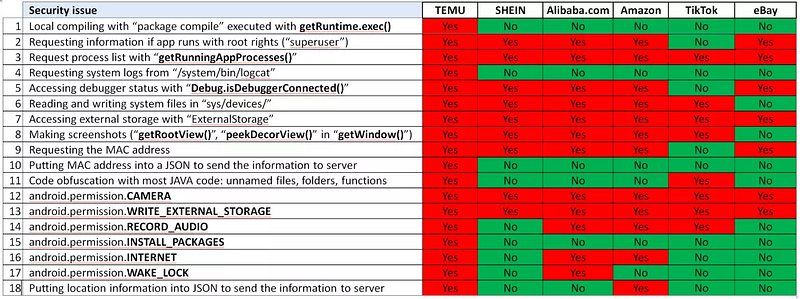
NOTE: when TEMU finds even one of the 18 threats, it turns red. So, it would be true of TikTok, with 10 greens; slightly less safe is SHEIN, with 9 greens; and among those with less-wise precautions, the matters uniquely flagged red by TEMU, from rows 1, 4, 10 to 15, form the most dangerous and are most likely to be amalgamated into substantiated spyware.
These problems then occur in areas of the code that are proprietary, obfuscated, or sourced from some rarely used code library; or they are poorly coded by some specialized company.
How the app became a Trojan horse
The app became the most downloaded in the US last year, the complaint by Griffin said, noting that very few of the users knew that the app was allegedly harvesting an alarming amount of sensitive user data, which is disproportionate to an online shopping application.
It also suggested that Temu could avoid detection by malware-scanning software by changing its behaviour when it detects a security scan by the user.
Further, Temu is said to access an Android device and use what Google considers to be a “high-risk or sensitive permission” to download any application it chooses “without the user’s knowledge or consent.” The complaint alleges that, while numerous apps need this permission to operate, “there is no legitimate reason for this feature in the Temu app, which purports to be just an e-commerce platform.”
Temu is not some harmless shopping app but more of a Trojan horse that gets into people’s phones, citizen’s lives, and even the security of the United States. The bank of data is reportedly rewarded to the Chinese Communist Party while Americans leak their digital privacy unintentionally. While other countries have come to their senses in doing something to avert the same type of threats, the United States must be at the forefront in defending its citizens.
Hope you find this article informative and useful in your day-to-day life. It is, therefore, very important to emphasize reviewing the permissions of applications in their respective app stores for all daily-used applications, whether messaging, shopping, or entertainment, to ensure that your data is safeguarded from unauthorized access without prior notice and consent.

 GizMunch
Leave a comment